Here is the recommended reading that I reference in my above lecture:
Greenhouse Effect explanation, from Joseph Romm, Climate Change: What Everyone Needs to Know (2016), pp 1-2:
The greenhouse effect has made life as we know it possible. The basic physics has been understood for well over a century. The sun pours out intense amounts of radiation across the electromagnetic spectrum, including ultraviolet and infrared. The sun’s peak intensity is in visible light. Of the solar energy hit- ting the top of the atmosphere, one third is reflected back into space—by the atmosphere itself and the Earth’s surface (land, ocean, and ice). The rest is absorbed, mostly by the Earth, especially our oceans. This process heats up the planet. The Earth reradiates the energy it has absorbed mostly as heat in the form of infrared radiation. Some naturally occurring atmospheric gases let visible light escape through into space while trapping certain types of infrared radiation. These greenhouse gases, including water, methane (CH4), and carbon dioxide (CO2), trap some of the reradiated heat, so they act as a partial blanket that helps keep the planet as much as 60°F warmer than it otherwise would be, which is ideal for us humans. At the dawn of the Industrial Revolution 250 years ago, CO2 levels in the atmosphere were approximately 280 parts per million (ppm). Since then, humankind has been pouring billions of tons of extra greenhouse gases into the atmo- sphere, causing more and more heat to be trapped. The main human-caused greenhouse gas is CO2, and the rate of growth of human-caused CO2 emissions has been accelerating. Emissions today are six times higher than they were in 1950. Moreover, CO2 levels have now hit 400 parts per million. As a result, the Earth has warmed 1.5°F (0.85°C) since 1900. Most of this warming, approximately 1°F, has occurred only since 1970.

This entry is licensed under a Creative Commons Attribution-NonCommercial-ShareAlike 4.0 International license.


This lecture contains a lot of interesting works, but I want to begin with a brief comment made while discussing political ecology. I would argue that Gen Z has been exposed to politics initially through the lens of climate, ecology, and environmentalism. Some of the first political events I remember hearing about as a kid were related to climate change, things like the Paris Climate Accord, which came into effect when I was 10. We are aware of events like the mass mobilization of protesters globally by Greta Thunberg, or Trump pulling out of the Paris Climate Accord a few years later. Growing up in this environment, our history and science classes always had an undercurrent of political ecology. The pervasive nature of the climate crisis is omnipresent. The crisis has evolved and become a more looming spectre in the last decade of our education, and I think it is clear that Gen Z bases much of our political thinking through this lens on both sides of the aisle, from climate denialism to ecoterrorism. Prof. Gerspacher commented about the leader of Iran before the Shah, Mohammad Mosaddegh, a man infamous in the Western world for doing what so many brave and intelligent leaders of post-colonial nations attempted to do: nationalize their oil. In 2013, Obama publicly acknowledged the U.S. role in the coup to overthrow Mosaddegh for this action. That was in 1953. Today, we see Iran being overthrown again, largely due to its not capitulating in the private companies’ bids for their oil, and refusing to give up their other (far more sustainable) source of nuclear power. Today, much of Gen Z protests these senseless oil wars that our country has waged since the beginning of our political consciousness. Works by Iranians like the late Marjane Satrapi’s Persepolis remind us of the humanity we lose in war, coups, and political violence. We must also remember that not only are these things political violence, but the climate crisis is a form of political violence as well, contributing to an ongoing cycle of suffering. The art of these protests has been incredible and widespread, and it’s very empowering to see the youth rally around saving the climate for the globe, not just a single nation.
I really like your point about how Gen Z has experienced politics through the lens of climate change. It made me think about Demos’ discussion in Blackout, where environmental crises are not presented as isolated natural disasters but as outcomes of political and economic systems. Your connection between oil, war, and political violence highlights this idea well. I also found it interesting that you mentioned Persepolis because it shows how large political conflicts are experienced by ordinary people. This connects to Professor Gerspacher’s lecture on fossil fuels, where energy is not just a resource but something that shapes governments, economies, and daily life. Your post made me wonder whether art is uniquely capable of helping people understand these connections in a way that statistics and scientific reports alone cannot. Could art be one of the most effective tools for motivating climate action?
This lecture had many great works and visuals that demonstrated these environmental issues very well in ways that were more than charts and data I thought might be the main usage of visuals. The art works that focused on oil the most had me staring at them for a while, one for how beautiful it looked to me and the other that had me deeply thinking for a while. The diagram shown by Brett Bloom called Petro Subjectivity struck me with how intertwined the usage of oil is in our lives. The minute we enter this world, our lives become the reason oil is needed to be used to provide us even the most basic necessities you would think did not have its involvement. From clothes to the very foods we consume, oil has been a part of its production in some sort of way which is something I have never thought about. I have very little to basic knowledge on environmental issues so this work had me pause and really look at each and every arrow to see how much my life contributed to the demand of oil. We all collectively have contributed to the demand of oil.
The other art work that really resonated with me was the oil spills and the animals. The first one being the oil fly. It is fascinating to see that one animal can make physical contact with oil that does not affect it negatively. Personally to me it is like a bit of hope that these issues are not permanent and there is a solution out there that we have yet to come across. I hope the research on this fly does provide us a solution for us to combat the climate issues we are facing. Although I do fear these flies might be somehow overused and mistreated for the information and usage they provide. They do bring to light on how we can find ways to combat these issues that lessen the need for oil. The oil fly reminded me about the dawn commercials made back then with the ducks covered in oil and they would use dawn soap to clean them off. Which does lead into the next artwork from the Tar museum that displays animals covered in oils on top of crates. The intention of showing how much care and fragility these animals are treated with once they are dead or no longer exist for display is, as mentioned, ironic. It is so strange to see how much human activity can disrupt animals and they will not care for them while they live and are heavily populated until they are needed for an art display. Preservation apparently matters after death and its sickening animals have to go through a lot before humans stop and take a look at a display and now the actively living creatures affected by their actions.
After reading Joseph Romm’s explanation of the greenhouse effect and the chapter Blackout: The Necropolitics of Extraction, I learned that climate change is about more than just the environment. It also affects people, communities, and even politics.
Romm explains that the greenhouse effect is a natural process that helps keep Earth warm enough for us to live on. Greenhouse gases like carbon dioxide (CO₂), methane, and water vapor trap heat in the atmosphere, which keeps the planet from becoming too cold (Romm, 2016, pp. 1–2). However, because people have been burning fossil fuels for many years, there is now too much CO₂ in the atmosphere, causing the Earth to warm faster than normal (Romm, 2016, pp. 1–2).
What stood out to me the most in Blackout was learning how environmental problems affect certain communities more than others. The chapter talks about places where mining, oil drilling, and other industries damage the environment and make life harder for the people who live there (Blackout, pp. 44–47). It made me think about how the people who contribute the least to climate change are often the ones who suffer the most from it.
I was also interested in the section about Puerto Rico. The chapter explains how disasters can create opportunities for companies and governments to focus on money and profits instead of helping local communities recover (Blackout, pp. 60–63). This connects to what Romm says about climate change because as the planet gets warmer, natural disasters can become more common and more severe (Romm, 2016, pp. 1–2).
Another part that caught my attention was the discussion about Bangladesh and rising sea levels. The reading explains how flooding and climate change are forcing people to leave their homes and putting entire communities at risk (Blackout, pp. 58–59). Reading this made me realize that climate change is already affecting people around the world right now.
Overall, these readings helped me understand that climate change is not just a science issue. It is also a human issue. The science helps explain why the Earth is getting warmer, while Blackout shows how those changes impact real people and communities. I think solving climate change will require both reducing pollution and making sure vulnerable communities get the support and protection they need (Romm, 2016, pp. 1–2; Blackout, pp. 44–67).
One idea that stood out to me from the lecture on fossil fuels is the relationship between visibility and responsibility. Fossil fuels power almost every aspect of contemporary life, yet the systems that extract, transport, and burn them are often hidden from everyday experience. Most people interact with energy through a light switch, a phone charger, or a gas pump, but rarely see the larger networks of labor, infrastructure, and environmental damage that make these conveniences possible. This made me think about how art can function as a tool for making invisible systems visible.
A connection can be made to T.J. Demos’s chapter “Blackout,” where he discusses disruptions to dominant systems and ways of imagining alternatives to them. What interested me most was the idea that a blackout is not simply the absence of light or power. It can also reveal how dependent society has become on systems that normally operate in the background. When power disappears, the infrastructure that usually remains invisible suddenly becomes noticeable. In a similar way, many artworks about fossil fuels attempt to expose the hidden environmental costs of modern lifestyles. They force viewers to confront connections between everyday consumption and planetary consequences that are often ignored.
This also relates to the Greenhouse Effect reading. Scientific explanations of climate change are usually presented through data, graphs, and measurements. While these forms of evidence are essential, they can sometimes feel distant or abstract. Art has the ability to translate scientific information into something emotional and experiential. Rather than simply informing viewers about rising carbon emissions, artworks can create a sense of responsibility or urgency. They transform climate change from a collection of statistics into a social and ethical issue.
What I find particularly interesting is that fossil fuels themselves can be understood as a type of archive. They are formed from ancient organic matter that has been buried and compressed over millions of years. In a sense, modern society is powered by the remains of prehistoric life. Every time fossil fuels are burned, a form of stored geological history is released into the atmosphere. This creates a strange relationship between past and future: humanity relies on ancient carbon to sustain the present, but in doing so, it alters the environmental conditions of the future. The climate crisis, therefore, becomes not only an environmental issue but also a temporal one, linking deep geological time with everyday human actions.
This perspective sheds new light on artworks dealing with fossil fuels. Rather than only criticizing environmental destruction, they can be understood as works that make visible the hidden histories embedded in energy systems. They reveal that fossil fuels are not merely resources but material connections between past ecosystems and future climate conditions. By exposing these connections, art encourages viewers to think beyond immediate convenience and consider the long-term consequences of how energy is produced and consumed.
“This made me think about how art can function as a tool for making invisible systems visible.” I really like that concept!
I love is responds. Made me think about how to make my personal artwork can be used to bring important situation systems that were built not to prosper the people…
As someone who comes from a purely environmental background when it comes to climate change, it was eye-opening to see how far-reaching and inequitable the effects of climate change really are. Ecopolitics is something I’m admittedly not as familiar with, so learning about how climate change disproportionally effects poorer communities puts what I’ve learned environmentally into a sociological framework.
In these last few months, it is nearly impossible not to see how deeply capitalist society runs on fossil fuels. Seeing the Strait of Hormuz blocked, and the catastrophic effect it has had on the global economy, has never made it clearer that we must find alternative sources of energy, or -gasp- forego many creature comforts. Since the Industrial Revolution, oil and fossil fuels have been irreversibly conjoined with human progress. Our increasing reliance on finite resources has caught up to us for decades in poorer communities, and is only now starting to catch up to us in first-world societies. Wealthy companies that profit from oil (sadly correctly) assumed that the effects of climate change would not be able to reach them for many years, and it continues to evade Earth’s wealthiest. They can stay in temperature-controlled mansions, further accelerating the excess of fossil fuel use. It is paradoxical that for us to feel a stable climate once more, we must use increasingly higher percentages of fossil fuels.
Sadly, because capitalism automatically defaults to the cheapest option, it is hard to implement climate-conscious policies that intentionally leave resources unused. Artworks such as Monira Al Qadiri’s Deep Float and Noriyuki Haraguchi’s Oil Pool challenge the idea that oil must be used in capitalistic consumption. Their defiance shows that we can similarly resist how oil runs the world. This is no small task, however. It requires pestering the highest powers enough to make them budge, as well as thinking of the collective instead of the individual, something exceptionally challenging in the United States. I hope enough people can come together to make a change.
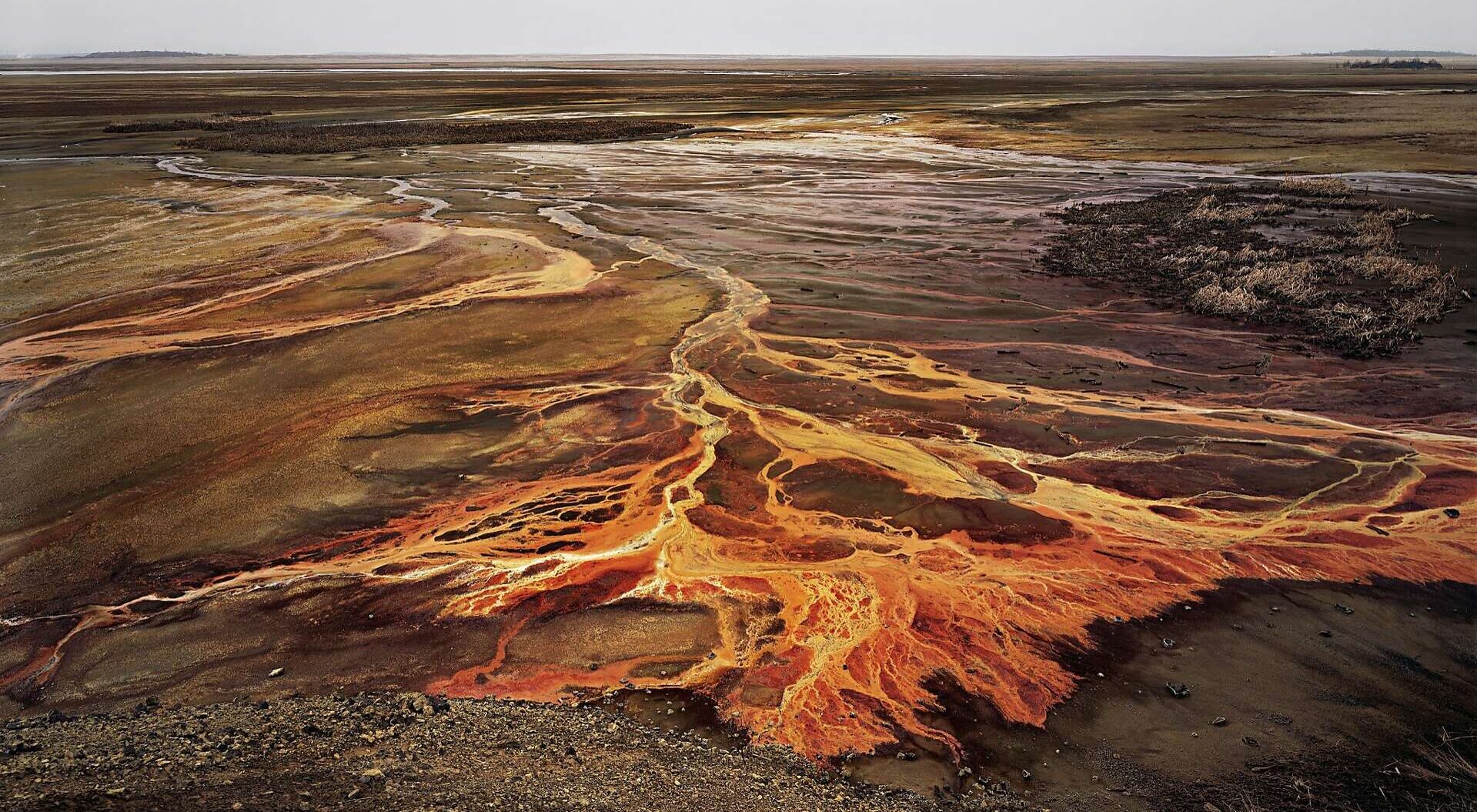
What stood out to me in today’s lecture was the image taken by Daniel Betra of the 2010 British petroleum oil spill… Alongside the questioning of whether it is a good or bad thing for it to appear visually beautiful. I do think it falls into the category of some sort of a pretty privilege, where it may not invoke the same sense of emergency in people to clean it up, adjust practices in order to avoid such events, or study the effects of these happens; the same way had the spill appeared to look less visually appealing and more representative of the destruction that it is invoking. Perhaps a more grim photo like the one of the pelican covered in brown oil is more appropriate in producing the outrage and sentiment needed to stop these petroleum companies from causing exponential destruction. Although I wonder if there is a deeper meaning in the 2010 image. Why does something so horrible look so beautiful, are there any other parallels to this in the world? Maybe it’s the same idea as some drugs that make people really good for the time being but the negative health effects they entail is similar to how oil spill causes ecological disintegration yet we continue to use them for their benefits. I also found the Diasmoreca fly to be very interesting, I attended a talk today where a professor is studying cholera outbreaks and their relation to gut microbiome which can be beneficial to combating the disease; alongside chestnut trees and their microbiome effectiveness in combatting fungus which almost wiped their entire population in the U.S. The fly being able to live off of the oil due to its gut ability seems so purposeful yet it’s an organism that is the opposite of pretty privilege (using this term pretty loosely) and often faces dismay. Also the thoughts on natural history museum’s highlighting these issues but still directly contributing to these issues; that’s something I’m always weary of especially when it comes to working in these spaces. It can be so contradictory to be sitting in a museum teaching about climate change while the very institution is shaking hands with the drivers of the environmental crisis. I find it harder and harder to be orthodox about not being involved in spaces/things that don’t agree with my environmental socio-political morals. It’s all so connected and heavily integrated into modern society. Even our tooth brush is a product that has oil involved in its synthesis. Even studying environmental science comes with a lot of pressure to use AI for manipulating and understanding Data. Which can admittedly be a useful tool but with the increasing cost of datacenters being built; siphoning water and life around them… at what point does that benefit to study the environmental problems become the environmental problem
whoops forgot to copy the question mark at the end.
Hey Aisha, I enjoyed reading your response as I had similar thoughts when looking at those specific works as well. At first glance and without context, the image looks beautiful. I question as well whether the beauty of it takes away from the serious issue it is capturing. People do not find outrage in beauty, they just admire it and only focus on that part. If it happens within the photo addressing a serious matter, how can anyone want to take it seriously? People have to be exposed to the raw and blunt truth of these environmental issues that are occurring and images like the pelican can provoke those emotions.
One of the works that stood out to me from today’s lecture was Kader Attia’s “Oil and Sugar” (2007.) As a Muslim, I immediately recognized the shape of the stacked sugar cubes as evocative of the Kaaba in Mecca, Saudi Arabia, the holiest site in Islam where millions of Muslims travel to each year to make religious pilgrimage, and by extension, a huge source of economic power for the Saudi government which makes a lot of money off of people arriving for pilgrimage each year. Saudi Arabia, of course, also controls a huge portion of the world’s oil reserves. A quick google search confirmed my guess that the artist, Kader Attia, has Muslim heritage, which makes me feel that the symbolism of the sugar cubes being in the shape of the kaaba and then slowly being corroded by oil was definitely intentional and maybe alludes to an idea of greed and extractivism for economic and political gain deteriorating human connection to spirituality and divinity.
Something else that I found interesting from today’s lecture/readings were these two concepts from Demos’ “Blackout”: 1) the ‘Becoming Black of the World,’ and 2) ‘Vanishing Geography.’ Demos quotes Achille Mbembe who writes, “Across early capitalism, the term ‘Black’ referred only to the condition imposed on peoples of African origin (different forms of depredation, dispossession of all power of self-determination, and, most of all, dispossession of the future and of time, the two matrices of the possible). Now, for the first time in human history, the term ‘Black has been generalized. This new fungibility, this solubility, institutionalized as a new norm of existence and expanded to the entire planet, is what I call the Becoming Black of the world.” I thought this was a really interesting concept, the idea that becoming ‘Black,’ originally a colonial and racialized term, could be used to mean a person robbed of self determination, time and of their future, and now be applied to people around the world affected by and impoverished by climate change.
The second concept from the reading which stood out to me, ‘vanishing geography,’ was used to refer to the phenomenon of thousands of people leaving Puerto Rico to the mainland U.S. for better living conditions as a result of natural disaster and economic debt which can be directly tied back to climate change and extraction of fossil fuels. Overall this concept of vanishing geography and also of certain countries taking on climate ‘debt’ in order for first world countries to continue extracting natural resources reminded me of my personal experience traveling to Bangladesh this past January. I had the opportunity to visit my ancestral village for the first time, located on Sandwip, a small island off the coast of Bangladesh heavily impacted by rising tides that come with the monsoon season each year. During my time there, one of my uncles took me and my family to a huge beach, that was made up of not sand but muddy dirt sparsely covered with grass that seemed to stretch on for miles. In contrast to the village, where the homes and buildings were close together (much more crowded now than it was when my dad grew up there 50 years ago, due to more people moving inland), this area felt really empty with only the goats wandering around and people who had come to enjoy the beach. There wasn’t a building in sight, and my husband remarked that it felt like we were at the edge of the earth. My uncle later told us that this whole area used to be full of people’s homes and eventually it had all washed away and turned into the beach that we were now on. It was beautiful in a way, because of how pristine the natural landscape seemed, but also thought-provoking because this beach only existed due to climate change that came from extraction and resulted in the displacement of so many people. It’s sad to think that one day the entire island might erode and with it, the village where my dad grew up, the trees that my grandfather planted, and all the people there moved to the mainland.